
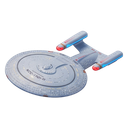

Engaging the Warp Drive
In the Star Trek universe, the Warp Drive uses dilithium crystals to generate a subspace bubble, allowing the ship to move faster than light (FTL) without breaking relativity.
The Scales (TOS vs. TNG)
- The Original Series (TOS): Used a cubic scale: warp factor cubed, times c. Warp 9 was fast, but they often went faster.
- The Next Generation (TNG): Recalibrated. Warp 10 is "Infinite Velocity" (occupying all points in the universe simultaneously).
- * Warp 1 = 1c (Speed of Light)
- * Warp 9 = 1516c
- * Warp 9.9 = 3053c
- * Warp 9.99 = 7912c (The curve is exponential!)
"Make it So"
Even at Warp 9, the galaxy is huge. Crossing the Federation (8,000 light years) would take over 5 years. That's why Voyager (70,000 light years away) was stranded for decades.
Why the Route Matters
Warp factors only give you a speed. The crossing time also needs a distance, and distance in the Alpha and Beta Quadrants is not a single line. Qo'noS and Cardassia sit on opposite sides of the Federation, so the run between them is far longer than either world's distance from Earth. Every world on this page carries a position rather than a distance, and the pair you choose is measured.
Four of those positions are real measured stars: Sol, Alpha Centauri at 4.4 light years, 40 Eridani A at 16.5 (Vulcan) and Procyon at 11.4 (Andoria). The rest are fiction and follow the licensed star charts, so treat them as approximate.